NexLev Niche Finder, Honestly Reviewed: What a Paid Niche Tool Does and Does Not Do
There was a stretch where I started niche after niche simply because somebody else had posted a revenue screenshot. I made close to twenty videos in one of them. The thumbnails were fine. The metadata was fine. Nobody watched.
It took me longer than it should have to work out what had gone wrong. The problem was never the editing. The problem was that I had chosen the niche on instinct, and the people quietly running real content operations were choosing theirs on data.
NexLev is one of the tools that comes up constantly in that conversation. So here is the honest version: what it actually is, what its filters really do, what it costs, and — more importantly — the part of the job that no tool is going to do for you.
What NexLev actually is
First, a correction I have had to make myself: it is not a browser extension. It is a web platform at nexlev.io, sitting on a very large database of YouTube channels, and you use it by logging in and filtering.
The core product is called Niche Finder. According to the vendor’s own documentation it lets you:
- Browse YouTube channels, either at random or through filters
- Filter by subscribers, average views per video, total views, channel age, video count and monetisation status
- Search channels by your own keywords
- Estimate a niche’s revenue potential through an RPM predictor
- Save interesting channels to a list for later analysis
- Work against a database that keeps ingesting new channels
Its real strength is not that it shows you what is going viral. It is that it collapses millions of channels down to a few dozen worth looking at. If you are building for an English-speaking audience from outside that market, that compression is the single biggest time saving on offer.
What it costs, stated plainly
This is the part most write-ups skip. At the time I checked, the vendor published two tiers, both one-time payments with lifetime access.
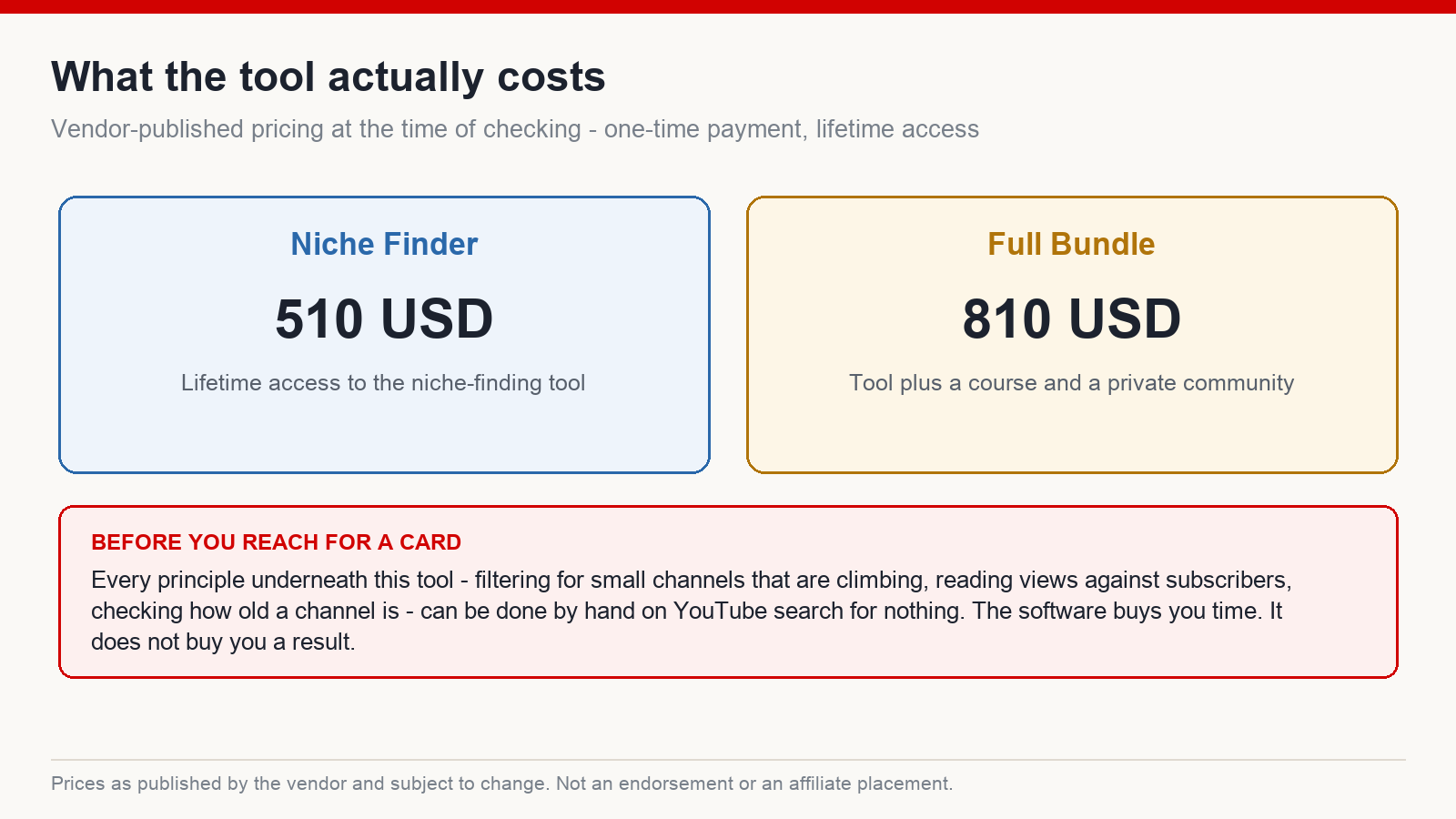
My honest read: if you have not yet run a channel that works, you do not need to spend that. Every principle underneath the tool — filtering for small channels that are climbing, reading views against subscribers, checking how new a channel is — can be done by hand on YouTube search for nothing. It will be slower. The software buys you time; it does not buy you an outcome. Prices also change, so treat any figure you read as a snapshot rather than a fact.
The mistake the tool is meant to fix
Most people choose a niche the same way: they see somebody share a topic and follow, they see a trend and jump, they see an inspirational format going around and reproduce it.
What usually happens next is that ten or fifteen channels are all making the same thing and none of them is getting anywhere. That is what a dead niche looks like from the inside — plenty of supply, no room left.
The five-step workflow
This is the order the vendor teaches, condensed:
- Log in and open the channel list.
- Either browse at random to widen your sense of what exists, or go straight to the filters.
- Apply the three filters that matter most (below).
- Look properly at the content, topic and growth shape of every channel that gets through.
- Save the interesting ones and analyse them later — do not stop to dissect while you are still filtering, or you lose the thread.
The three filters that matter
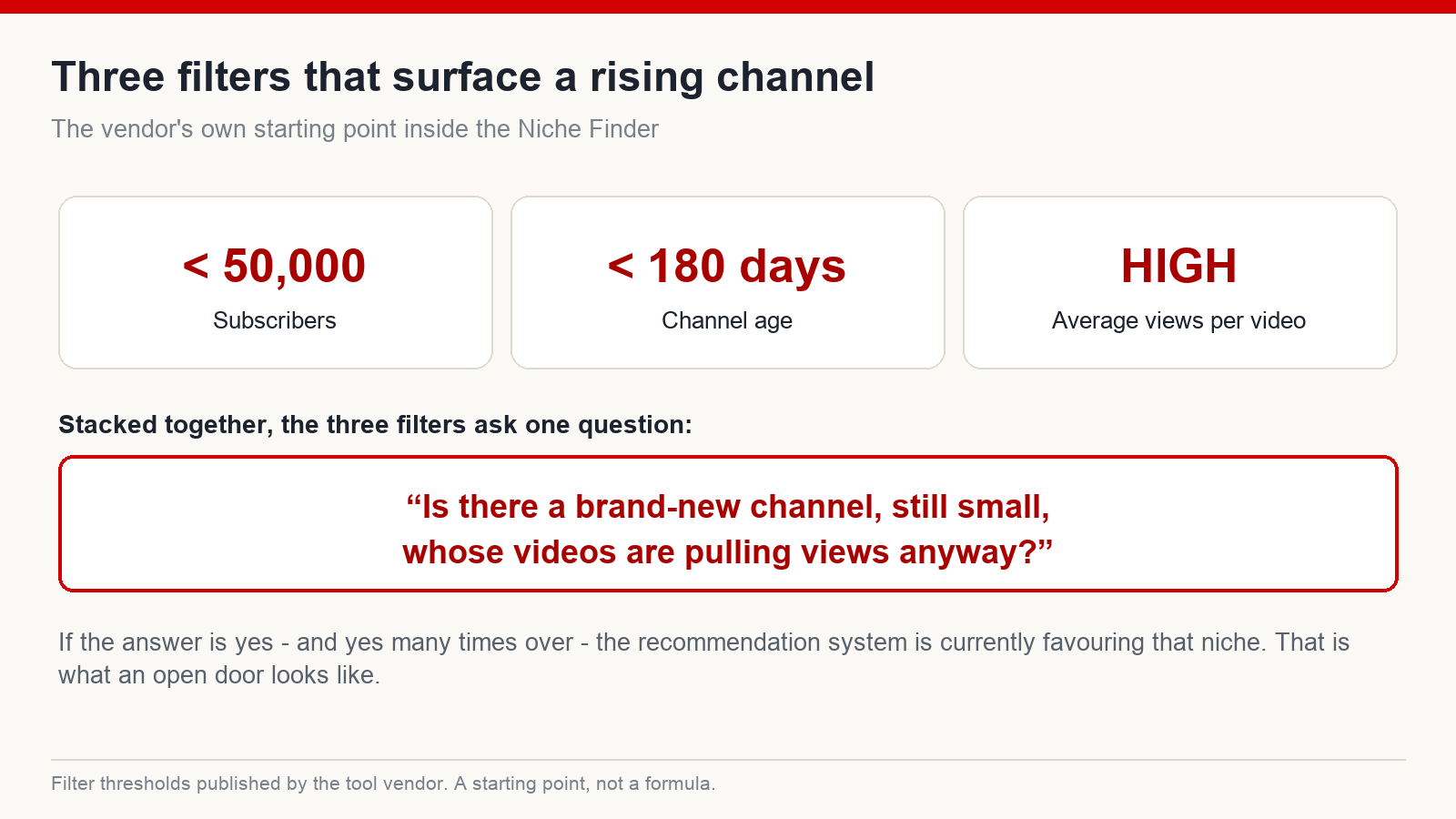
Fewer than fifty thousand subscribers. A channel younger than roughly a hundred and eighty days. High average views per video.
Stacked together, those three ask exactly one question: is there a brand-new channel, still small, whose videos are pulling views anyway? If the answer is yes — and yes repeatedly, across several channels — then the recommendation system is currently favouring that niche. That is what an open door looks like.
Those thresholds are a starting point published by the vendor, not a law. Every niche sits at a different level.
The metric most people ignore: views against subscribers
The reading is simple.
Few subscribers but high average views means the platform is pushing that content beyond the channel’s own audience. The door is open.
Many subscribers but weak average views means the channel is dying in recommendations, and the niche has probably saturated.
I am deliberately not going to give you a rule of thumb like “two thousand subscribers and fifty thousand views is good”. That number would be fiction. Relaxation content, children’s content and finance content sit on completely different baselines. What you are reading is the ratio, and you read it across many channels at once, never a single one.
Then cross-check with your own eyes. Open the channel, go to Videos, sort by Popular, and shrink the browser window until the grid is about three columns wide. The repeating content lines rise straight out of the thumbnail block. It is the first thing I teach in a workshop, and it costs nothing.
Two schools of niche research — a filter tool only serves one
People blur these into one sentence, and they are genuinely different jobs.
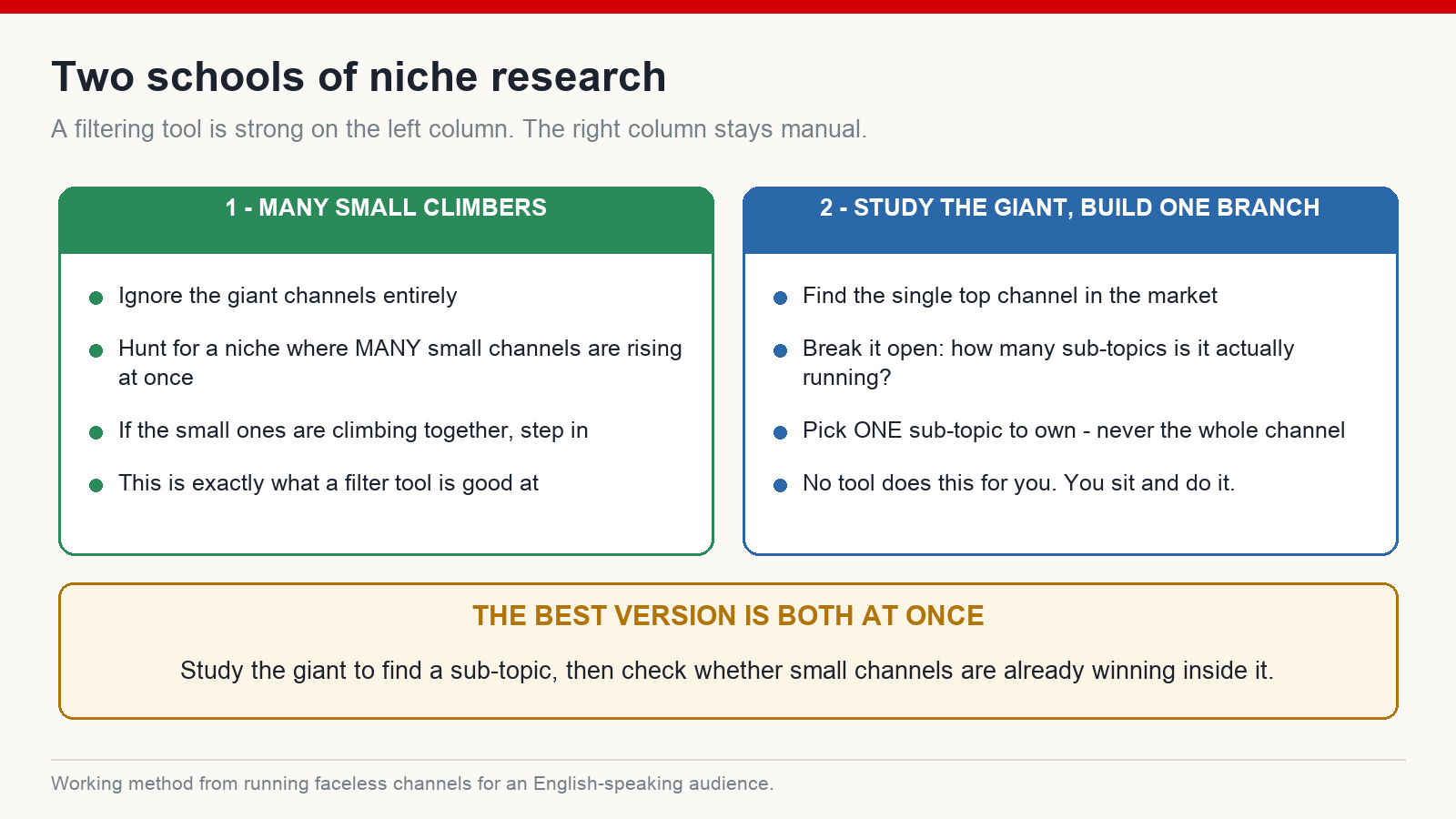
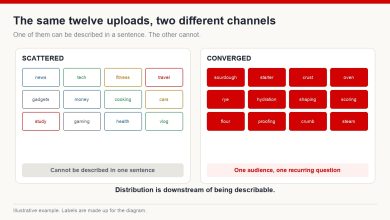
Many small climbers. Ignore the giants entirely. Hunt for a niche where a lot of small channels are rising at the same time, then step in. This is precisely what a filter tool is built for — the subscriber and channel-age filters exist to surface exactly that crowd.
Study the giant, build one branch. Find the single top channel in a market, break it open, work out how many sub-topics it is actually running, and pick one to own. Never the whole channel — one branch of it. No tool does this for you. You sit down and do it.
My team runs both, depending on the goal. If we want to open new territory we dissect a large channel to find an unworked branch. If we spot a cluster of small channels climbing, we join it and push further.
The strongest version is both at once: study the giant to find the sub-topic, then confirm that small channels are already winning inside it. When both signals point at the same branch, you are about as sure as this work allows you to be.
The part no tool does: drawing the niche tree
A tool hands you a list of channels. It does not hand you a content system. The gap between those two is where most beginners fall through.
So before anyone I work with touches a paid tool, I make them draw a niche tree on a blank sheet of paper.
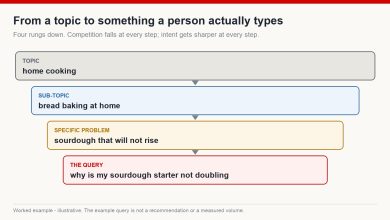
The topic goes at the top and branches downward. Animals splits into wild and pets. Wild splits into big cats, reptiles, grazers. Big cats splits into lions. Box each branch, draw the lines, and write the keywords in English from the start.
The working definition is refreshingly simple: anything smaller than the thing above it is a niche.
And the single most useful trick on the page: a horizontal line drawn between two branches is a combination, and a combination is a video. Lions versus crocodiles. Lions versus pythons. The tree is not just a classification system — it manufactures video ideas.
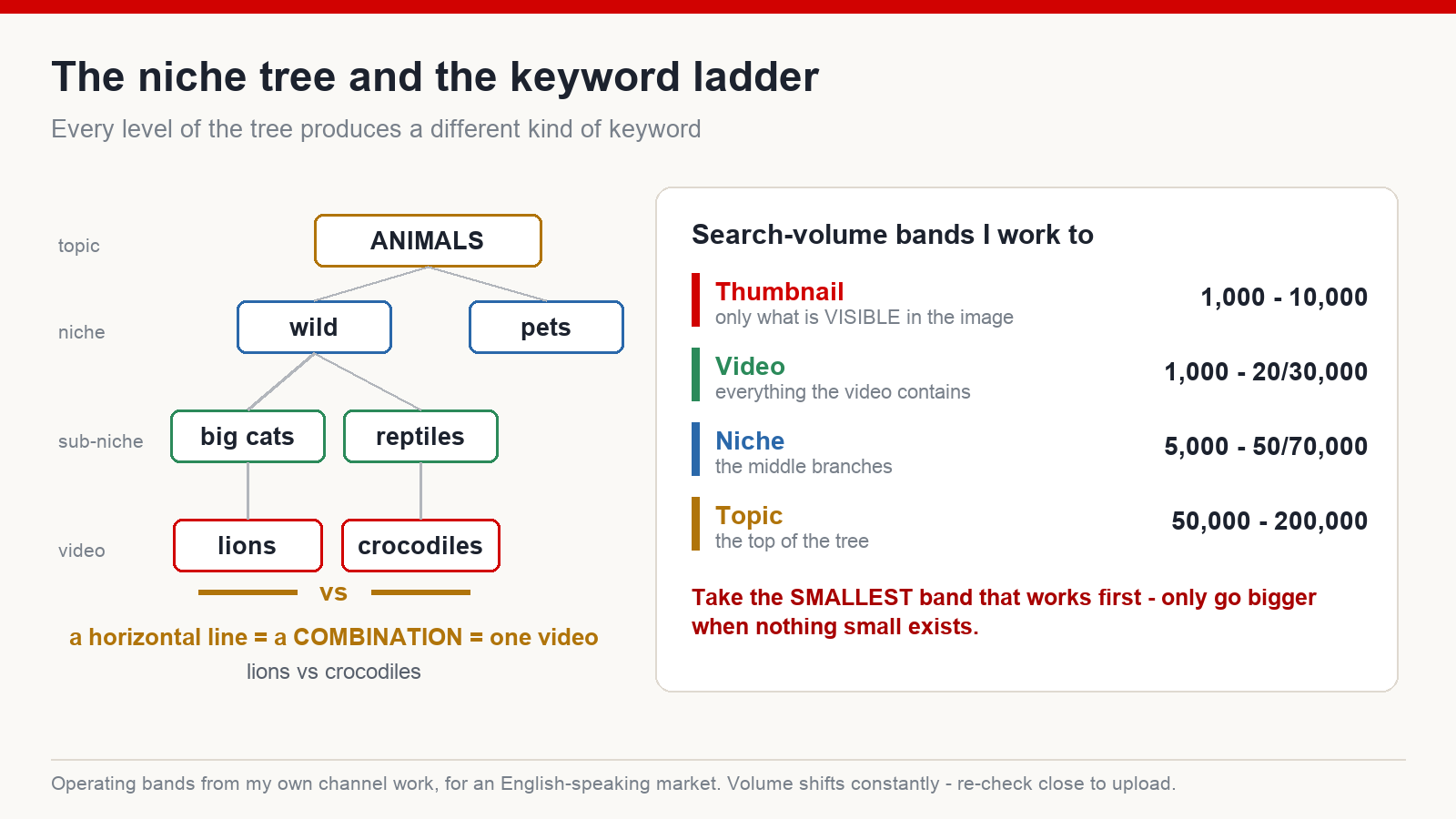
Drawing it does not mean building all of it. Next you check which branches your competitors and the market are actually working, mark the ones that are climbing, and develop those. This is where a filter tool genuinely earns its place: you arrive with a tree already drawn and use the software to see which branch has small channels gaining traction.
Each level of the tree produces a different kind of keyword
These are the bands I work to for an English-speaking market:
- Thumbnail keywords — only what is visibly in the image — roughly 1,000 to 10,000
- Video keywords — everything the video contains — roughly 1,000 to 20,000 or 30,000
- Niche keywords — the middle branches — roughly 5,000 to 50,000 or 70,000
- Topic keywords — the top of the tree — roughly 50,000 to 200,000
The selection rule matters more than the ceiling: take the smallest band that works first, and only go bigger when nothing small exists. The commonest error is grabbing a thirty-thousand keyword and hanging it on a thumbnail; the mismatch shows immediately. For an English-speaking market, anything above a thousand is usable.
One exception is worth memorising: containment is not the same as volume. The topic “wild animals” might sit around a hundred thousand while “lion attack” sits higher, even though lions live inside wild animals. The reason is intent — the further into a niche someone searches, the more specifically they want that exact thing. General searchers are browsing.
Use the data to rebuild intelligently, not to duplicate
This is the strongest use of research data, and it has nothing to do with copying.
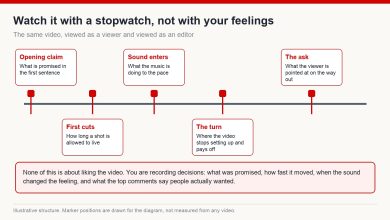
When a video is climbing, I look at the hook in the thumbnail, the angle in the title, which sub-topic is doing the pulling, and which videos hold attention longest. Then I do not clone it. I change the audience, change the telling, change the hook, change the problem being addressed.
A generic video about using AI to work faster can be split into: AI for teachers, AI for new parents, AI for freelancers, AI for someone who has just been made redundant. Same engine, four different vehicles.
There is one axis my team missed entirely until we looked properly at competitors: localising by place. They were putting the region at the front of the title — Congo, Amazon, Pantanal, Masai Mara, Alaska, Mexico, the Philippines. Same python, same crocodile, but the word “Amazon” makes it a different video. Every ecosystem is another episode and the supply of ideas barely runs out. The principle holds: smaller is better. An audience that watches “Africa” over and over gets bored; you have to go smaller inside Africa.
Why people buy the tool and still fail
Because they look at which video went viral and never at why it went viral. Those are very different questions.
YouTube is no longer a place where you can copy a thumbnail, swap the title and expect to be carried. The system reads viewer behaviour, retention, comment quality, session length and how similar your content is to everything else already on the platform.
So duplication eventually costs you the channel. And to say it directly: this is not a tool that guarantees you will earn anything. It helps you read data more accurately. The outcome still depends on the quality of what you make and how long you are willing to keep making it. Anyone selling you software with an income promise attached is worth being suspicious of.
The rhythm I actually work to
It is unglamorous. Every day: analyse ten channels, record average views, compare views against subscribers, find the recent winners, save the strong hooks and titles.
After a week to ten days of that, a repeating shape starts to appear. That shape is usually the real niche.
One habit that separates good research from wasted research: do not look at all-time top videos, look at what has climbed in the last thirty days. Plenty of channels have a monster hit from last year and flop with everything they publish now. Read the wrong window and you will walk confidently into a market that closed months ago.
A good niche has three things at the same time
Real search demand. People are actively typing it, rather than you imagining they might.
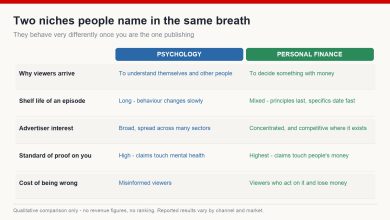
An audience advertisers want. This is a large part of why creators build for English-speaking markets in the first place — revenue per thousand views tends to be higher there. Tools that estimate this produce estimates, not commitments.
Durability. The videos do not die three days after publishing.
Where this leaves the tool
A niche finder does not make you go viral. It helps you avoid building in the wrong place, and sometimes choosing correctly at the start saves months of failing slowly.
But do not confuse the order of operations. The hand-drawn tree, reading a competitor’s thumbnail grid, picking one narrow branch and attacking it directly — those are free, and they decide considerably more than the software does. The tool shortens the search step. It does not replace the thinking.
YouTube stopped being a contest of who works hardest some time ago. It is now a contest of who reads the data best and then still turns up consistently. If you would rather practise that on a real channel than read another article about it, that is what I run at mmoyoutube.com.
Frequently asked questions
Is NexLev free?
At the time I checked, the vendor published only paid tiers — a one-time payment for the Niche Finder and a higher one for the bundle with a course and community. I found no free plan. Pricing can change, so check the vendor’s own page.
Is it an extension or a website?
A website. You log in and use the filters in the browser. Nothing is installed.
Which filter thresholds are correct?
The vendor suggests under fifty thousand subscribers, a channel younger than about a hundred and eighty days, and high average views per video. That is a reasonable place to begin, not a fixed formula — every niche sits at a different baseline.
How many average views make a niche good?
There is no single number that transfers between niches. Read the ratio of views to subscribers, and read it across many channels rather than one.
Should I remake a competitor’s video?
Learn the structure, yes. Reproduce the video, no. The platform is increasingly good at detecting near-duplicate content, and channels built that way tend not to last.
How many competitors should I analyse?
Ten to fifteen at a minimum. Looking at one or two and concluding a niche is promising is the quickest route to losing several months.
What if I cannot afford a paid tool?
Do it by hand. Draw the niche tree on paper, filter YouTube search by upload date and video length, study the Popular grid of a reference channel, and note every channel with few subscribers and strong views. It is slower, it reaches the same kind of conclusion, and you learn to read the data yourself instead of depending on someone else’s dashboard.